How architects can use local SEO to win higher-value projects
If you want your architecture practice to be found by the right clients, local SEO is what connects your work to the way people actually search. It helps Google understand your services, your location and the type of projects you want to attract. Done well, it brings in enquiries that are aligned with your budget, your style and your way of working.

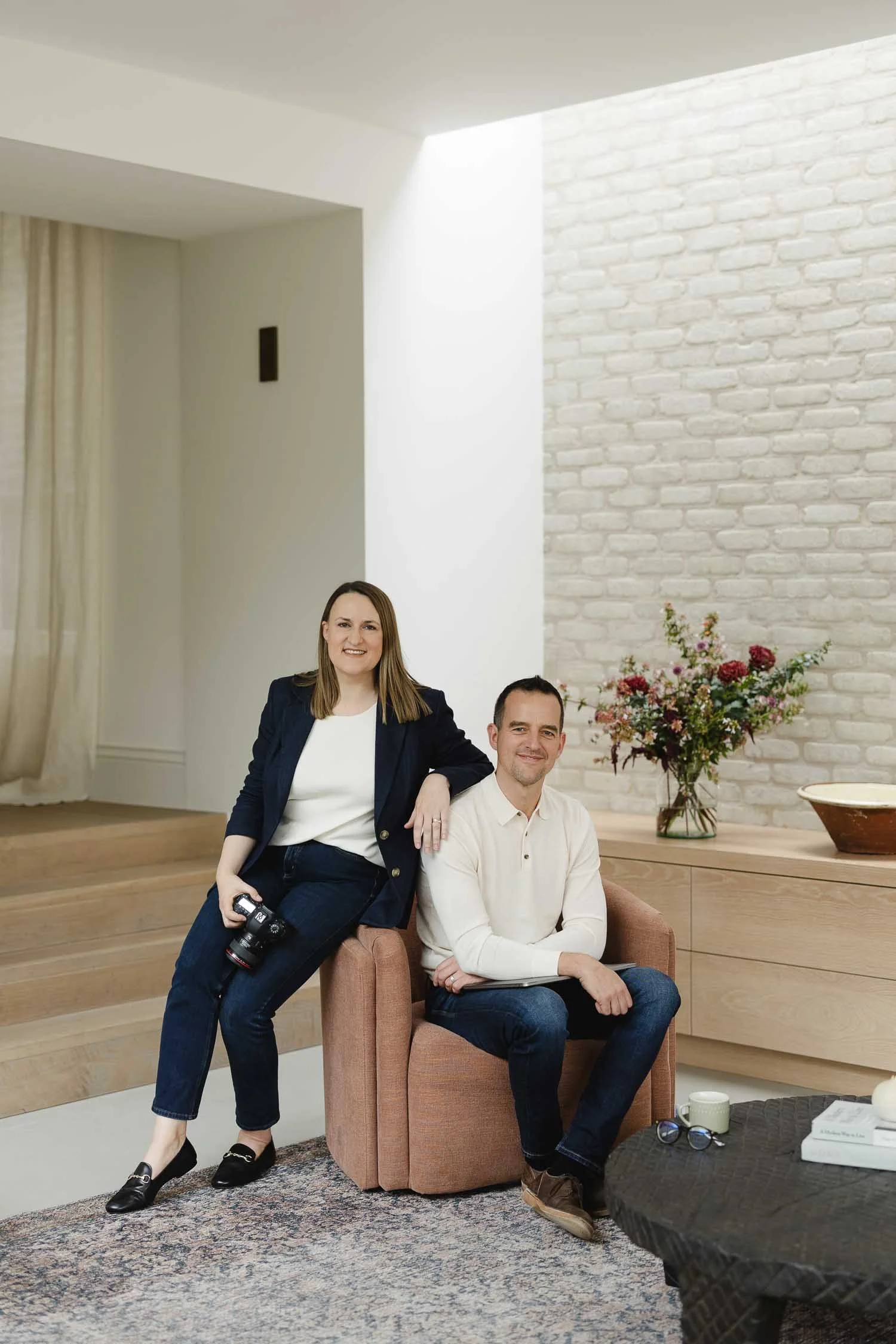
Rachael leaning against a white wall while Simon sits in a chair holding a magazine
Why local SEO needs a different approach for architects
For many architects, local SEO can feel slightly uncomfortable because it appears to pull against the quietly confident and minimal aesthetic that is sought after by so many architecture practices. However, good local SEO is not about turning your website into endless sales pages or cramming it awkwardly with keywords. At its core, it is simply about helping the right people understand what you do, where you work and why your architect practice is relevant to their project.
The challenge is that architecture clients rarely search in neat or obvious ways. They search through problems, locations and slightly vague aspirations, often without knowing exactly what service they need. This is why effective local SEO for architects depends less on technical tricks and more on clarity: clear positioning, clear content and a website structure that connects your expertise to the real questions potential clients are already asking.
Top takeaways on local SEO for architects
Local SEO only works for architects when it’s built on clear, relevant content not image-heavy websites alone
The goal is not more traffic, but better aligned enquiries from the right clients in the right locations
Strong positioning and client-led language are essential for attracting ideal projects rather than general enquiries or time-wasters
Referrals are valuable for architects, but local SEO helps create a more predictable and scalable pipeline of work
SEO success comes from people-first content that answers real client questions rather than chasing keywords
Clear service pages, location pages and portfolio examples help search engines understand your expertise and relevance as an architect
A well-optimised Google Business Profile is a key way to signal trust and drive your visibility locally
Broad or generic SEO tactics often attract the wrong architecture clients and dilute the quality of your enquiries
The most effective local SEO strategy for architects combines content, structure and positioning rather than technical tweaks alone
1. Why local SEO is a challenge for architects
Local SEO can feel slightly at odds with how many architecture practices naturally present themselves online. Beautifully minimal websites, strong reliance on imagery and a referral-led pipeline all shape how architects show up, but they also create blind spots when it comes to search visibility. Before you can improve your local SEO, it’s worth understanding where these tensions actually come from.
Architects’ websites often suffer from a minimalist design
By nature of the profession and their design tendencies, architect websites tend to lean towards a lean, pared back aesthetic. Although aesthetically pleasing, the problem with is it that it involved little to no text content; it relies heavily on images to communicate the messaging; and utilises a very pared back navigation and user journey.
In terms of local SEO, these tendencies create problems for architects, often undermining their efforts to be visible in organic search results. Good local SEO is highly reliant on on-page text content. Without this text, it makes it very difficult for search engines to understand what the page is about and who it’s for. This then translates into poor local SEO and creates a vicious circle for the architect’s website.
Added to that, very large, unoptimised images also slow down an architect’s website, because they are slow to load, particularly on mobile devices. Google prioritises the initial load speed on mobile phones with small screens. To cap it all off, if the user journey and navigation of the website don’t make it easy for the user to find information and trust what the architect firm is promising, the end result is simply people navigating away and bouncing back to Google; all of which further damages the SEO performance of the site.
Architects rely on referrals more than organic searches
Many architect practices grow their businesses through word of mouth, doing one good project after another; this is the best kind of marketing, as referrals need much less effort to convert into live projects. However, word of mouth and referral marketing can hit a ceiling after which it is hard to make headway - for example, if you’ve exhausted opportunities in a particular area or a pool of clients.
The other challenge is that while referrals help build up an architect’s practice in the early days in a nice and sustainable way, they can reduce the urgency to invest in local SEO. The net result of an architect practice ignoring its website and not doing local SEO well is that it then limits visibility to new, higher-value opportunities beyond existing networks. Organic search results open up a variety of large, rich areas in which to market, allowing an architect to stay viable beyond referrals (although we always recommend retaining that as a marketing channel).
Search visibility often attracts the wrong type of client
Many architects find themselves in the frustrating position of being visible via their website, but attracting less-than-ideal clients. Local SEO can be a double edged sword: get it right and a reliable stream of the right clients come knocking on your door; get it wrong and you end up running round in circles answering the same questions and constantly trying to communicate the limitations of small budgets.
Attracting the wrong clients is the result of confusion about how local SEO works. For example, it’s not just a case of getting words on page, but being really clear about how you position your architect practice and targetting the right clients with the right content. Architects may fall down with local SEO by inadvertently ranking for broad search terms that bring in low-budget or misaligned enquiries rather than the ideal clients they actually want.
Architecture services are complex and hard to search for
The reality is that architects offer sophisticated, high-value services, which might include complex planning regulations, commercial spatial planning or lighting psychology. Clients on the other hand rarely search in neat, service-based terms, which makes it difficult for architects to align their website content with real search intent and local demand.
A client’s awareness of an architect’s services or offerings might only extend to a loft conversion or a floorplan. In fact, they may not know where to start, and perhaps end up taking on the services of a business in a different, but aligned industry by mistake, leading to a lot of frustration if the project doesn’t meet their initial needs or solve their problems.
Key ideas:
Minimal, image-led architect websites often lack enough text content for search engines to understand and rank them effectively
Reliance on referrals can cause architects to delay investing in SEO, limiting their long-term visibility beyond existing networks
Poor positioning and broad visibility can attract low-quality or misaligned enquiries rather than ideal clients for architects
2. What architects actually want from local SEO
For most architects, the goal should not be more website visitors, but better enquiries. People who understand the value of your designs, have the right budget and are aligned with the way your practice works. Local SEO becomes useful when it shifts from being an exercise in visibility to a a way to consistently bring in the right kind of work.
More of the right enquiries, not just more traffic
As we’ve mentioned, more traffic to your website doesn’t translate into valuable enquiries. Local SEO should always be focussed on driving the end conversions: moving people from getting on the site to making an enquiry.
Overall, if you’re an architect ideally you want your local SEO to bring clients to your website who are in alignment with your budget expectations; your typical project scope; and have design ambitions that match your vision for your practice. This is the ideal for your website and your local SEO rather than a simple increase in website visits.
Greater visibility in the areas they want to work
Whether you’re targeting a local town, area of a city or an affluent neighbourhood, as an architect you want to be found by clients who are searching in the locations that best suit your practice and your portfolio of work.
Better visibility is one of the greatest benefits of good local SEO on your website, as clients generally accept that it’s best to work with someone local. Local architects are more likely to understand local clients’ issues plus can more easily be on hand for meetings or site visits.
A steady pipeline beyond referrals
Local SEO helps architects reduce reliance on word of mouth alone by creating a more consistent source of high-quality enquiries through search.
Although word of mouth referrals will always be the best form of marketing, there comes a point where an architect practice needs to cast the net wider. Being able to build a deeper, more reliable funnel of enquiries means less anxiety about cashflow. It also makes it easier for an architect practice to build its team and plan for the future, knowing its finances are more stable.
Key ideas:
The goal for architects should be better-quality enquiries, not just increased website traffic or visibility
Strong local SEO helps architects appear in the specific locations they want to work in
A consistent search-driven pipeline reduces reliance on referrals and improves business stability
Websites for architects that work harder
At Wildings Studio, we help architects create thoughtful, strategically designed websites that not only reflect the quality of their work, but also improve visibility, build trust and attract more aligned enquiries. Our approach combines calm, editorial-style design with clear positioning, user experience and long-term SEO thinking.
If you’d like to explore more ideas around branding, websites and marketing for architecture practices, browse the articles on our blog for architects and design-led businesses. We regularly share insights on positioning, SEO, content strategy and creating websites that support sustainable practice growth.
Thinking about a new website or refining your current one? You’re welcome to get in touch with us here to discuss your project, goals and the direction you’d like your practice to move in.
3. How local SEO helps architects attract the right clients
At its best, local SEO simply helps the right people find you and your architect practice at the right moment. It connects your practice to real search behaviour, rather than making assumptions about how clients might look for an architect. When you get that alignment, enquiries tend to feel more relevant, more engaged and easier to take on.
It connects your practice with local search intent
Local SEO helps your website appear when potential clients search for services in specific locations, making it easier for the right people to discover your practice at the moment they need it.
Being able to present your architect’s practice and services to a potential customer exactly when they are looking for those things is incredibly powerful. That’s why local SEO is so powerful when done properly. It takes all the guesswork out of your website marketing and ensures that you meet people where they are at their point of need in a relevant and tailored way.
It attracts clients looking for your type of work
By targeting specific services, project types and locations, local SEO helps bring in enquiries that are better aligned with your expertise and ideal scope of work.
As we’ve discussed already, architecture covers a lot of ground and customers are often unaware of what they actually need when it comes to it. Local SEO allows you to be really specific about how your website is served up to potential clients based on their particular needs. Being able to identity and target niches like this makes for more efficient marketing, as clients are more likely to be in a place to proceed with a project.
It builds trust before the first enquiry
Strong local visibility, clear service pages and location-specific content help clients feel confident that you understand their area, their needs and the kind of project they want to create.
Trust is the keystone of an effective website, and local SEO allows you to get a strong, relevant message across as soon as a client encounters you. This is a very powerful way to build trust at the start of a customer’s journey, removing the need for them to work out whether your architect practice is relevant to their needs and aspirations. Customers want to know what you do, for whom, where you are and that you can solve their problem: local SEO allows you to put those key elments front and centre.
Key ideas:
Local SEO aligns your architect practice with real local search intent, meeting clients at their specific moment of need with a relevant offering
It filters enquiries by service type and project fit, improving alignment with your expertise as an architect
It builds early trust through clarity, visibility, and relevance before a client makes their first enquiry
4. When local SEO matters for architects (and when it doesn’t)
Local SEO matters most when your work is tied to specific locations or when clients are actively searching for an architect in their area. It matters less if your reputation, referrals or business networking already do most of the work. Knowing where you sit helps you invest your time and energy more wisely for your practice.
It matters when clients search by location
The power of local SEO for architects lies in how targeted you can be. Rather than taking a scattergun approach to you marketing, you can identify and go after specific locations. Given that clients like to work with local companies that have more of a connection to where they are (and can get to know better), local SEO allows you to connect your content with the specific needs of clients. For services such as home extensions, planning support or listed building work, clients often want someone local who understands the area, making local SEO especially valuable
If you think about cold callers on the telephone or who doorstep you, it’s often very frustrating, as they interrupt you when you are in the middle of something or don’t have a particular need at that point. Local SEO allows architects to present themselves to clients who want local architect services at precisely the right time, removing all the annoyance and friction of cold marketing.
It matters when your services are location-led
Similarly, architects often want to work with local clients or have particular specialisms related to a location or geographical area. As such, local SEO allows your architect practice to define your playing fielding and the terms on which you compete within your preferred parameters. If your work depends on regional knowledge, planning constraints or a strong local reputation, local SEO helps reinforce your visibility and credibility in the areas you want to serve
Local SEO makes a difference if you want to deliver your architecture services to specific locations, as it increases the volume and likelihood of enquires that match your specialism and preferred work. This reduces the amount of admin and time you expend on fielding enquiries that are the wrong type for your architect practice; rather it helps you get in front of more of the right clients, boosting your overall revenue.
It matters less when work comes through reputation alone
On the flip side, local SEO is not necessarily a silver bullet if you have strong, alternative marketing channels, plus SEO can bit a double-edged sword. For high net-worth clients, often Google is not their first port of call. High value clients put much more emphasis on personal relationships and who they can trust via word of mouth. This is why very big architects’ websites are often quite minimal and don’t content much content. They are not relying on local SEO to drive enquiries; potential clients already know about them and are sold on their reputation before they even arrive.
Another downside of local SEO if you’re an architect is that it can drive a huge amount of low value traffic and enquiries to your website. If you don’t want to be a mass-market architect, preferring instead to offer high-value, high-expertise services, you don’t want to attract clients with low budget expectations. Equally, there won’t be huge numbers of people searching for these specific services, so SEO might not be the best investment. (Not that local SEO can still attract niche audiences.)
Overall, if your architect practice relies almost entirely on referrals, repeat clients or collaborations with aligned contractors, local SEO may play a smaller role, though it still supports credibility and future growth.
Key ideas:
Local SEO is most valuable when clients are actively searching by location for specific architecture services
It supports architect practices when they are very location focussed or have specific regional expertise (and want to position themselves that way)
It plays a smaller role when repu
5. The foundations of local SEO for architects
Strong local SEO for your architect website isn’t about technical tweaks on their own. It comes from clear, useful content, well-structured service pages and a website that loads quickly and feels easy to navigate. These foundations help both Google and your potential clients understand what you do and whether you’re the right fit.
High quality, relevant content that answers searches
Content is the most underrated, but powerful, aspects of local SEO for architects. Although technical SEO has its place (like optimising titles, meta descriptions or Core Web Vitals), without underpinning a website with great content, technical tweaks and twiddling just won’t deliver traffic (unless your site already has a considerable amount of content).
The best foundation you can give your architect website for local SEO is simply: answer the questions that people ask Google (or a search engine). This is the ultimate way to build traffic; and once you get that traffic you can improve your conversions. Without traffic coming to your website, all other work becomes somewhat futile. Our top tip is to think carefully about what your ideal clients are looking for in searches and then reflect that back to them through your blog content.
Clear service pages improve search relevance
Building on your blog content, having clear, focussed services pages will help your architect website in a number of ways. Firstly, it allows you to connect them up with your traffic generation pages - these will generally be your blog pages, as discussed above. Once you have attracted a warm audience by creating relevant content that offers value to people searching, you can sign post those visitors to your core architect services pages. This shows that you not only understand people’s architecture problems, but have the skills and experience to solve them.
In terms of search engines, having a set of clear service pages for your architect website signals the relevance of what you offer to Google. By ensuring that you are as relevant to specific searches as possible, you increase the chances of your website pages being served up in the right searches. Obviously, the more you can do this, the more traffic you get and the more potential enquiries. Overall, focused pages help Google understand your services, locations and ideal client enquiries.
Fast websites create better search experiences
Another area that architect websites fall down in is their website’s load time. Because architects often favour minimal, image-led designs, they resort to uploading very big images. This not only makes it frustrating for visitors, as the site becomes slow to load, particularly on mobile devices, leading to people clicking away; but also Google then downgrades the SEO of the website, because it picks up on visitors’ behaviour. It then becomes a bit of a vicious circle.
The way to maximise local SEO for your architect website is firstly by optimising the images you upload on your site. Practically, this means each image’s file size, dimensions, filename and alt text. Reducing the size of images will make the biggest difference to the load speed of your site. Alongside image optimisation, ensuring a good structure (thinking about your customer journeys), navigation and menu system will help to improve your site’s usability and engagement which are helpful signals for SEO.
Lastly, don’t forget to set up your Google Business Profile as this also strengthens your local SEO visibility: an optimised profile helps you appear in the highly visible Google Maps ‘map pack’ and is another way to reinforce trust, underlining you’re a legitimate local business.
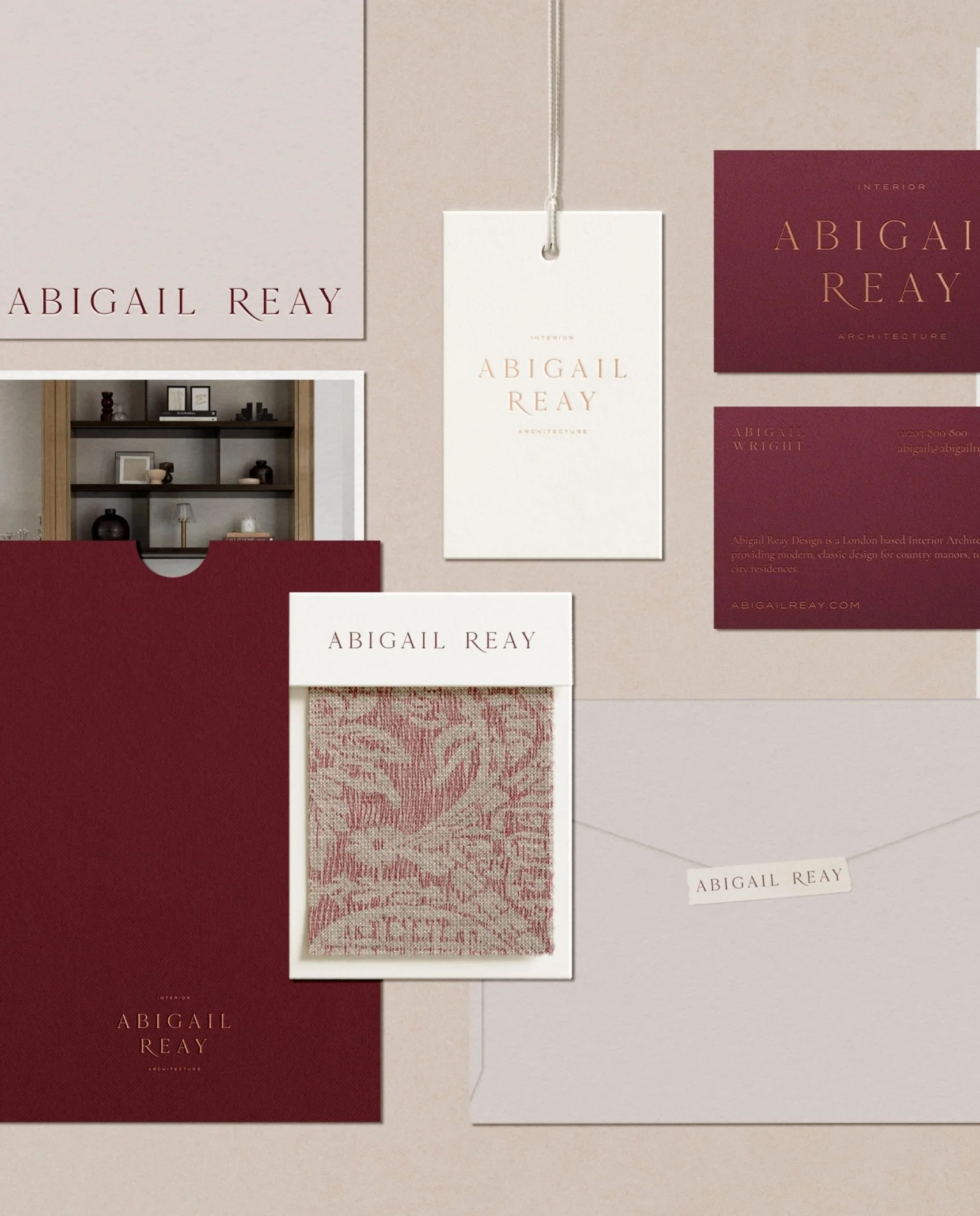
Abigail’s elegant interior architecture studio branding, featuring burgundy business cards textured fabric samples and her minimalist logo
Example: Full brand identity for an interior architecture studio
Abigail Reay Design is a London-based interior architecture studio whose work goes well beyond decorating rooms — encompassing space planning, lighting design, construction and the technical depth that separates interior architecture from interior design.
When Abby came to us, she had a clear vision but no brand to carry it. She needed everything built from scratch: logo, colour palette, typography, stationery and a website — all communicating the luxury and rigour her clients expect, without losing the warmth that makes her practice distinctly hers.
We developed a full identity system, from primary logo and monogram mark through to business cards that have since earned, in her words, "sooo many compliments!" The website followed, built to attract the right clients and position her with confidence.
As Abby put it: "I was blown away by the results and feel they understood where I wanted to take my brand."
Explore Abigail Reay Design's brand identity on our portfolio →
Key ideas:
High-quality, people-first content is the primary driver of visibility and search performance for architects
Clear service and location pages help search engines and users understand what you offer and where you are based
Fast-loading, well-structured websites backed up by a strong Google Business Profile improve trust and rankings
6. How to position your practice to attract ideal clients
Your positioning as an architect practice underpins everything in SEO. If you’re not clear on the projects you want, the budgets you work with and the language your clients actually use, your content will always feel slightly off. Strong positioning brings focus to your visibility and helps the right enquiries find their way to you.
Define the projects you want more of
The step to get going with local SEO is to define who you want to work with and what those projects look like. Otherwise, any content or SEO work will be guesswork and untargeted, which is highly ineffective and an efficient way to use SEO. As we mentioned in the intro, there are an astronomical number of ways to end up on ‘page one of Google’ because every search result is tied to a specific search query, and there are infinite variations. As such, there has to be a strategy sitting behind SEO.
Specifically, think about your preferred budgets for your architecture projects; which specific services you are offering; and any other key nuances, such as the architectural style, or things that are relevant to your geographical location, as mentioned earlier on. Once you have this clarity and thinking around your positioning in place, your local SEO efforts are much more likely to attract clients who are aligned with what you want, plus keep away those who will drain your time and efforts.
Use language your ideal clients recognise
Using the language that matches your clients is critical to local SEO if you’re an architect. The key principle here is relevance. If the language (i.e., words, phrases) on your architect website doesn’t match the language that your clients readily use or put in searches, you are much less likely to appear in search results. As such, you need to get in the mind of your clients and focus on their language, which builds connections and helps visitors quickly understand your practice and expertise.
The other trap architects fall into is creating content that is just not relevant to their desired clients. A couple of common examples include: firstly, talking about industry awards or internal achievements. In general, clients don’t care about these things; they want to know whether you can solve their architecture problems. Secondly, creating content that is related to architecture, but again irrelevant to what clients are looking for, such as architecture you found interesting on holiday. Even if it is in the general architecture sphere, it’s simply not what your clients are looking for, so ineffective for local SEO.
Show work that reflects your desired direction
Your portfolio generally won’t be a frontline page in your SEO, but it plays an important part in driving conversions. If you imagine that your blog pages provide the entry ways to your website by addressing the burning questions clients have, your portfolio projects provide the evidence that clients need before making an enquiry about your architect services. They provide the trust and back up the claims that you make on your service pages.
Remember, less is more when it comes to the portfolio projects on your architect website. Clients need to see just enough to make a decision to enquire, not your entire back catalogue. Too many projects causes paralysis, as a visitor doesn’t know what to look at or what’s relevant. Also, the reality is that most architect practices evolve over time and get better at defining the type of work they want to do. As such, weed out portfolio projects that no longer represent your ideal clients or projects. By only including the most relevant portfolio projects, you reinforce your credibility and attract enquiries similar to your strongest previous work.
Key ideas:
Clear positioning around project type, budget and style ensures local SEO attracts the right enquiries for architects
Using language that is natural to clients improves your relevance and helps your content match real search behaviour
A focused architecture portfolio reinforces your credibility with clients and filters enquiries toward your desired type of work
7. Content strategy for architect SEO
Content is where your local SEO as an architecture practice either starts working or falls flat. The most effective approach is simple: answer the real questions your clients are already asking in discovery calls, e-mails and initial enquiries. From there, everything else, including links to location pages and portfolio projects, start to fall into place.
Create content around real client questions
As you may have realised above, content is the foundation of local SEO if you’re an architect. As long as your website is not broken on a fundamental level, the best place to invest is content. As Google, says ‘There are actually very few technical things you need to do to a web page; most sites pass the technical requirements without even realizing it.’ In its Search Essentials guidelines (part of its SEO Starter Guide), it moves the emphasise squarely onto content. Namely, the core practice that can have the most impact on your web content's ranking and appearance on Google Search is creating helpful, reliable, people-first content.
Most architects are more than capable of addressing this, as they deal with clients day in day out, so know the questions, challenges and issues people face from discovery calls or live projects. Practically, it’s then a case of writing content on your blog that unpacks these client-focussed question in a way that’s helpful, show’s expertise in the subject matter and accessible by a normal human being. Helpful blog articles that address the exact queries that clients have, improve your search visibility plus build trust with potential architecture clients who are searching locally and exploring options or their problems.
Write location-specific content for relevant services
A lot of architects get SEO locations pages the wrong way round: they think that if you have four, maybe five, locations pages on their website, this is the magic key to unlocking ‘page one of Google’. Examples, include ‘architect services in London [or insert particular location]’. The problem with this is that it completely ignores the value of creating ‘helpful, reliable, people-first content’ (see above). As an architect, if you’re not first writing content that answers the questions your customer puts in Google, no matter how many location pages you develop, you won’t get traction overall with your SEO. ‘But people do Google ‘architect near London [or insert location]’ you say. Even if they do, by prioritising locations you fall foul of the key Search Essential above; a location-page first strategy, is putting SEO or search engines first. Answering questions on your blog first and linking them to location pages is the appropriate, people-first approach.
What this looks like practically is using your blog pages to drive the increased traffic to your location pages. Including clear links to your location pages (where relevant) in your blog articles shows that you are relevant and have expertise for location specific searches for your architect services. The other thing to mention is unless there is a good reason, avoid writing the same blog article for multiple different locations. This runs the risk of duplicate content, which Google dislikes. Instead, write one authoritative blog article per architect or architecture topic and then include links to the most relevant location page. You can also link to your blog articles from your location pages to underline your expertise in certain areas. Overall, targeted content will help your architect practice appear in searches when connected to specific places and project types
Use projects to demonstrate expertise and authority
A critical part of an architect’s website is the portfolio with specific case studies: this helps potential clients by showing what a practice is capable of and its style. It’s also helpful for local SEO. While clients are unlikely to undertake direct searches for portfolio related terms, architect portfolio pages are important for reinforcing credibility and feed into stronger rankings for specialised architectural services.
As with location pages above, we would always advise using your architect portfolio case studies to reinforce the main content on your blog, rather than lead the process. For example, if you tackle a particular topic in your blog, incorporate a short section that provides a real-life example of how you’ve solved a similar problem for a client. Within the section, ensure to link to the portfolio page on your website. This internal linking (same for location pages above) creates an SEO lattice work that constantly underlines to Google and human visitors that you are a credible authority, not only on the topic but for the services you offer.
Key ideas:
Content on your architect website should directly answer real client questions based on insights from project conversations and enquiries
Blog content should lead SEO with location pages supporting (not replacing) people-first content
Use case studies and internal linking to reinforce your authority and help underline the relevance of your content topics and relevance to local searches
8. How to avoid SEO tactics that attract the wrong clients
Not all traffic is useful. Broad keywords, generic topics and search-first writing can bring in enquiries that don’t match your architect practice. The aim isn’t visibility at any cost, but clarity, so the right clients understand you quickly and the wrong ones naturally self-select (out, ideally!).
Avoid broad keywords that attract unsuitable enquiries
The most common problem architects encounter with local SEO and their website is not being strategic enough and not being focussed enough with keywords or blog titles. As we’ve discussed, architectural services covers a wide spectrum and there is no fixed ‘page one of Google’, so SEO is all about being as focussed and relevant as possible, keeping your clients in mind.
If you stick to broad keywords and high level architect or architecture topics you’ll probably notice a couple of things. Firstly, you may not get an increase in traffic; you may see an increase in impressions in your Google Search Console data, but a low click through rate. This demonstrates that while your content is relevant (to an extent) it’s not specific enough. Secondly, you might increase traffic to your architect website, but fail to drive any enquiries (because it’s not problem-solution focussed) or the enquries you do receive overall are low in quality.
Don’t prioritise rankings over client alignment
Another misconception of local SEO for architects is that it’s all about rankings and traffic. While this is true one one level - you do need to be visible and without traffic you can’t get enquiries - it’s not the full picture. Going back to your SEO strategy, rankings and traffic need to have the end in mind, so if your local SEO is constantly pushing clients or projects that are a poor fit for your architecture practice, something is wrong.
If you’re an architect and considering local SEO as a marketing channel, effective SEO should drive better-fit projects rather than simply generating higher visitor numbers. High website traffic is simply a vanity metric if it’s not producing conversions. The best conversions will include phone calls, people filling out your enquiry form or e-mailing you. Others to be aware of are people adding their e-mail to lead magnets in your blog articles. These all help you drive your architect business forwards productively, rather than give an illusion of growth.
Avoid content written purely for search engines
If we return to Google’s Search Essentials again, one of the main things that can help improve how your site appears in Google Search results is to focus on people-first content. This means content that's created primarily for people, and not to manipulate search engine rankings. It’s hard to make it clearer than that: if you think that you can pull the wool over Google’s eyes with anything like keyword stuffing, churning out AI content or creating near duplicates of content, local SEO won’t do one iota for your architect practice.
The best and only way to avoid SEO tactics that attract the wrong clients is to focus relentlessly on the questions that your ideal clients search for, and answer them. There really isn’t a way round this, no matter how much people talk about technical SEO or spending time on areas that don’t change the actual content on your website. Search engine focussed content is ultimately low-quality: it damages the authority of your website, erodes trust and attracts less engaged or poorly matched prospective clients.
Key ideas:
Broad architecture keywords and topics often attract low-quality traffic and reduce the relevance of enquiries
Rankings and traffic only matter if they lead to well-aligned high-quality client enquiries
Local SEO for architects should remain people-focused; over-optimised or generic content will weaken your trust and authority
9. Practical ways to improve your local SEO now
Once the foundations are in place (which are not necessarily complicated), improvement comes from consistency rather than complexity. Clear service pages, an up-to-date Google Business Profile and regular, helpful content all work together to steadily improve how visible your architect practice is in local search.
Refine your service and location page structure
Assuming that there are no major technical issues on your website, the best place to focus for improving your local SEO as an architect is structure and content. It’s important to remember not to spend too long on structure though, as content is the main driver of traffic. Regardless, firstly ensure that you have one page for each of your core architectural services. An ideal number is three, as beyond that it becomes overwhelming and difficult for clients to work out your architecture specialism. These core services pages will become key pillars to link back to from your ensuing blog content.
Don’t worry about going into details about the exact locations you cover with as an architect practice; you can mention in broad terms what your main geographical locations are. You can then focus on your locations pages, which is where you can be ultra-specific about the areas and neighbourhoods connected with one of your services. Note that you can end up with a huge number of location pages, so be smart and targetted with how you go about this, as you’ll need to maintain these pages, if your business changes. Also, don’t simply create carbon copies of the same page - each page should be distinct and have merit in its own right, otherwise your SEO efforts will be wasted.
Update your Google Business Profile regularly
Your Google Business Profile plays an important part in your local SEO as an architect - if you haven’t set it up yet, make sure you do; it’s quick and easy. Your Google Business Profile is the profile that appears if someone searches for your business directly, otherwise, people can find it via Google Maps if they search for architects in their local area. It pays to ensure you have a Profile and it is as visible as possible.
Once you’ve done the basic setup steps, your main activity will be keeping it up to date. Adding Updates, photos & video and capturing Google Reviews are the main ways to do this (beyond your opening hours). Google Reviews are incredibly powerful for social proof if a potential customer is comparing you with another architect practice. Get in the habit of asking clients for a testimonial after every project. Make sure you adhere to Google’s guidelines for collecting reviews → Adding regular updates, photos and videos is another quick and easy way to signal the relevancy of your business and build trust. Repurposing social media content is a good way to update your Google Business Profile if you’re unsure what to add.
Publish content answering common client search queries
We’ve said this before and we’ll say it again: answering the questions your ideal clients ask is the best way to get traction with local SEO as an architect practice. Hands down (unless your site is already massive or has issues). Helpful content supports your long-term rankings, while simultaneously attracting more informed and better-aligned architecture enquiries.
Google’s search algorithm works differently to the social media algorithms that we have become accustomed to. Whereas social media rewards engagement (likes, comments or shares), which creates a vicious cycle and rewards ever more extreme content, Google rewards the best quality content that is most helpful for visitors. Plus, once a piece of content does well, it generates a life of its own and can become evergreen if you curate it every so often. This is a subtle difference in priorities, and is why local SEO is so powerful and rewarding when done well, rather than ephemeral and soul destroying on social media.
Key ideas:
A clear structure of your service and location pages provides the foundation on which to build your blog content and grow your SEO
A well-maintained Google Business Profile will strengthen your visibility in local search and builds trust
Regular, helpful content that addresses real client questions is the only way to drive sustainable long-term SEO performance
Conclusion
Local SEO for architects is not about chasing rankings or trying to game Google. It’s about making your practice easier to understand both for search engines and potential clients. When your architect website clearly explains what you do, who you work with and where you work, you create a much stronger connection between your expertise and the people already searching for it. And this ‘timely’ element of local SEO is why it’s so powerful.
The architect practices that tend to get the best results from local SEO are not necessarily the loudest or the most technically obsessed; they are usually the clearest: they publish high quality, helpful content; structure their websites thoughtfully with the user in mind; and position themselves around the type of architecture projects they want more of. Over time, that clarity and local SEO creates a compound affect, so your website drives a steady, reliable source of aligned enquiries.
If you take one thing away from this article, let it be this: good local SEO starts with understanding your clients’ architecture questions and answering them as best you can. No tricks and no tweaking meta descriptions endlessly. Focus on useful, relevant content and a website that reflects the quality of your practice.
If your architect website feels beautifully designed but difficult to find, or if your enquiries no longer reflect the direction you want your practice to move in, it may be time to rethink how your content, positioning and SEO are working together.
At Wildings Studio, we help architect and design-led practices create websites that feel calm, clear and strategically grounded, balancing thoughtful design with search visibility and long-term growth. If you’d like a second pair of eyes on your website or local SEO strategy, you’re welcome to get in touch for a conversation.
Frequently Asked Questions
-
Local SEO is usually a long-term strategy rather than a quick fix. Architect websites often begin seeing improvements in visibility within a few months, but meaningful enquiry growth depends on the quality of your content (which is why we kept underlining it above); how competitive your keywords or target locations are; and how well and clearly your branding has positioned your architect practice to appeal to your ideal clients.
-
The best content answers real life client architecture questions helpfully and, if possible, in a way that’s relevant to a location (although this is not mandatory). If you’re an architect, this would generally include articles about planning permission, extensions, listed buildings, renovation challenges, project costs and location-specific architectural considerations (e.g., oast houses in Kent or extreme weather in Scotland).
-
Although it’s not essential, local SEO will strengthen your visibility beyond existing your networks and help future-proof your architect practice. Even if your practice relies on referrals, you can certainly benefit from appearing in search results if a potential client looks you up online before making contact. Overall, it increases the impact of your marketing which is always a good thing.
Read more: local SEO insights for architects
Search Essentials from Google, which is Google’s own documentation on how search works and what it considers high-quality content. This is the ultimate guide on people-first content, avoiding spam tactics, creating genuinely useful articles and not over-focusing on technical SEO.
Google Business Profile guidelines from Google (again!), with best practices for managing your Google Business Profile, improving local search visibility, Google Maps and trust signals.
Future Trends Report from RIBA (the Royal Institute of British Architects), which is an authority in the architecture industry and provides more context to the points above on enquiries, workload pipelines, referrals and long-term practice growth. It shines a light on the real commercial realities facing UK architecture practices today.
About the author:
Simon Cox is the co-founding director (along with his wife, Rachael Cox) at Wildings Studio, a branding, website design and content marketing studio in Torquay, UK. He’s the writer and editor of the Wildings Studio blog which you’re currently reading. Simon is also responsible for the Wildings Studio content marketing services. Simon blogs regularly on topics to do with the core Wildings Studio services on branding, website design and content marketing (blogging). He’s passionate about helping small business develop great content that answers the questions people type in Google in order to get found online (SEO).

About Wildings Studio
Thoughtful, beautiful branding and websites for design-led businesses
Wildings is a website designer for small businesses offering website design. Based in South Devon, UK, we deliver small business website design for design-conscious brands like garden designers, interior designers, architects, circular ethos restaurants, speciality coffee shops, organic cafés and boutique hotels.