How interior designers can stand out & attract better clients
Standing out as an interior designer requires a brand identity that aligns your unique interior design philosophy with the specific needs of your ideal client. By moving beyond a simple logo to a brand identity underpinned by a defined brand strategy, cohesive visual assets and a distinct tone of voice, you create the professional credibility needed to attract higher-value interior projects. Explore how to refine your positioning as an interior designer to stop blending in and start resonating with the right people.
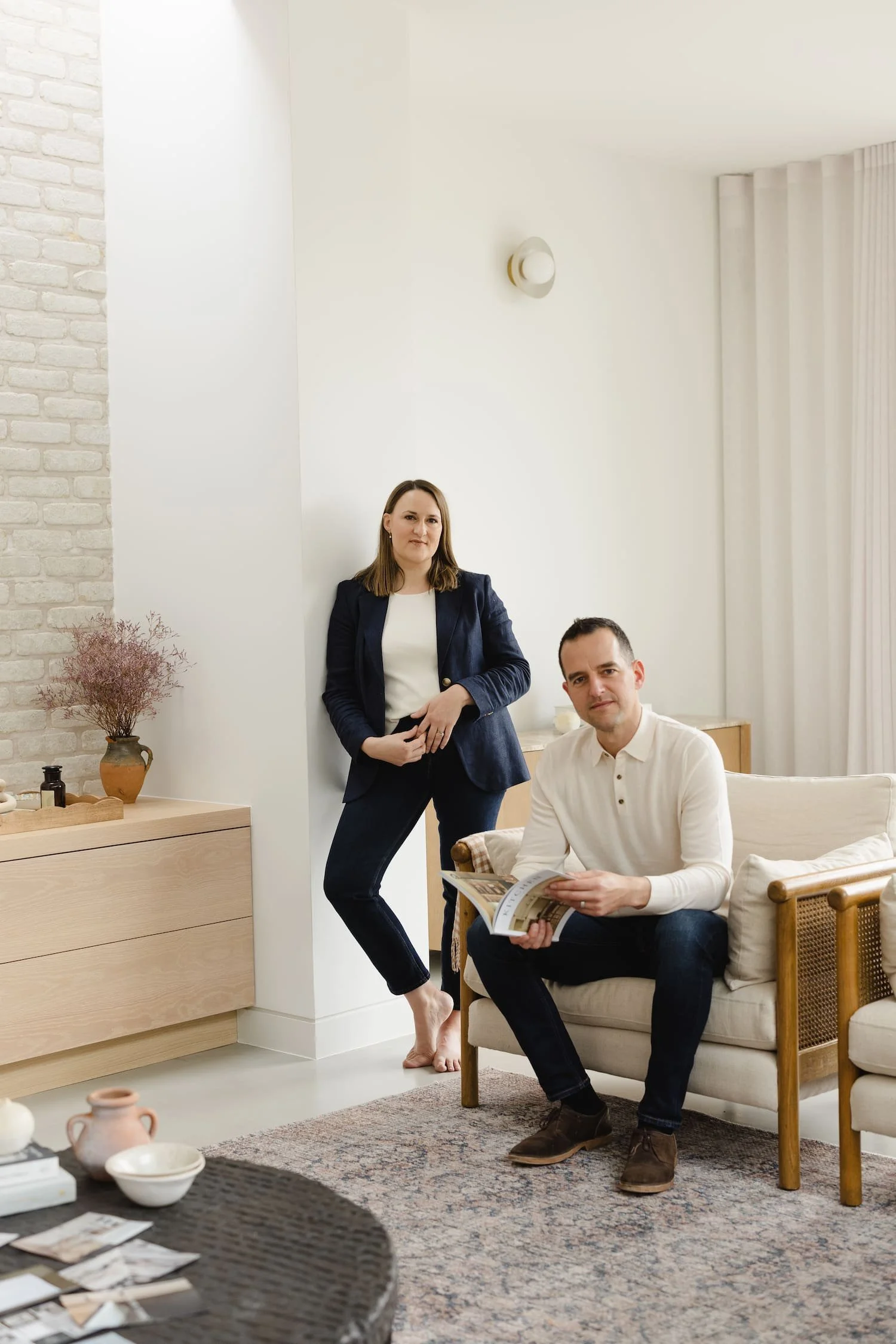
Rachael leaning against a white wall while Simon sits in a chair holding a magazine
Why standing out as an interior designer starts with your brand identity
Before diving into the detail of brand identities for interior designers, it’s worth stepping back to acknowledge a general pattern: most interior designers don’t struggle because of a lack of talent, but because of a lack of clarity in how they present themselves. When your brand identity isn’t clearly defined, even exceptional work can be overlooked or undervalued. This is what creates a frustrating disconnection between the quality of your interior design projects and the type of enquiries you receive.
Below, we’ll break down exactly why the interior design market feels so saturated, where many interior designers go wrong with their branding and how a strong, strategic brand identity can reposition your interiors studio. The aim is simple: to help you move from blending in with competitors to becoming a recognisable, trusted and in-demand interior designer.
Ten top takeaways on brand identity for interior designers
Strategy always comes first Before you even think about a logo, you need to define your design philosophy and your ideal client. Visuals created in a vacuum, without a strategic purpose behind them just won't work for your business
The vicious circle of market saturation The market feels crowded because many designers look and sound identical. The barrier to entry with interior design is low, but the barrier to excellence is high. A unique brand identity is what separates a professional from a wannabe
Consistency builds the trust you need Using mismatched fonts or inconsistent photography styles creates dissonance. If a client feels uncertain about your brand's look, they will feel uncertain about trusting you with their home
Solve problems, don't just sell aesthetics Clients don't actually want to know how great you are. They want to know you understand their specific frustrations and have the vision to solve them. Your brand should lead with empathy and solutions
Identify your colour season Utilising colour psychology (Spring, Summer, Autumn, or Winter palettes) helps align your brand's energy with your design style. This creates an immediate, subconscious connection with the right audience
Avoid the race to the bottom If your brand isn't recognisable at a glance, clients will compare you based on price alone. A strong identity allows you to compete on value and style rather than who is the cheapest (which is soul destroying)
Your logo and assets should be scalable A logo that looks delicate on a business card might disappear entirely on a site banner or scaffolding. Ensure your visual toolkit includes variants that work across every physical and digital touchpoint
Your voice is as important as your portfolio Branding isn't just visual; it is verbal. A distinct tone of voice on your website and social media reinforces your perspective and makes your studio far more memorable
Don't over-invest too early If you are a brand-new startup, be mindful of your budget. You want to get your branding right the first time, but not at the expense of your studio’s initial profitability
Use your brand to attract higher-value work If you want to move away from churning out small projects, your brand must feel aspirational. Higher-value clients need to see a level of professionalism and expertise that mirrors the investment they are about to make
1. Why does the interior design market feel so saturated today?
Today’s interior design market is incredibly competitive. This has been driven by our now highly-digital age, with short form video supercharging the demand for comfortable, aesthetically-pleasing homes. Equally, with relentlessly rising inflation and the COVID-19 pandemic, property has allowed developers and homeowners to maximise their investments by doing up and selling on houses.
This has resulted in a three pronged affect: firstly, huge demand for home improvements across the board; secondly, a lower barrier to entry for those wanting to become an interior designer; and thirdly, highly aspirational and viral social media content creating a formidable feedback loop.
It doesn’t help that interior design is not particularly regulated, which means that anyone from an home stylist to an architect can quite easily offer what appear to be interior design services. This creates a lot of confusion and ambiguity among the general public, making it hard for potential customers to discern and choose a professional interior designer, distinguishing them from those who are merely taking advantage of the demand for interior design.
Despite these challenges, there are still big opportunities for brands who want to stand out in the interior design space. The demand for interior services means that businesses with attractive and unique brand identities can still perform and be successful - and this is what we’ll get into below.
Key ideas:
Increased demand has driven more designers into the market – Social media and property trends have accelerated interest in interiors
Low barriers to entry create more competition – A lack of regulation allows a wide range of people to offer interior design services
Social media creates a cycle of imitation – Viral content encourages similar styles making many designers appear interchangeable
2. Why interior designers need a distinctive brand identity
To be blunt, if you want to survive as an interior designer you need to stand out, and having a distinctive brand identity is one of the best ways to achieve this. Because there is so much competition among interior designers it makes it much harder for potential customers to choose one from dozens of designers.
Without a distinctive brand identity, the danger is that you simply disappear among legions of other interior designers. Only the designers with the best, unique, characterful and interesting brand identities stand any chance of cutting through and resonating with clients.
If your strategy is based on hoping that simply by stating you’re an interior designer and listing your services that you’ll magically win clients, you’ll be sorely disappointed. A brand identity doesn’t just create a beautiful aesthetic, but importantly gives your ideal clients a reason to choose you above and beyond others. It’s what stands behind the visuals that gives it power.
A distinctive brand identity gives you another advantage: it helps position you in the interior design market. Interior design covers a huge range of products and services. Knowing where you fit in the interiors world then allows you to carve out a niche. If you establish a niche you stand a much better chance of standing out. Rather than attracting lots of the wrong attention (e.g., price shoppers), a well-crafted brand identity attracts the right clients for your interior design business. Success is being able to do more of the right interior projects, with the right clients for the right price - a brand identity helps you achieve this goal.
Key ideas:
A brand identity helps you stand out in a competitive market – A distinctive brand prevents your studio from blending into the background
A brand identity positions your studio within a clear niche – Strong branding defines where you sit in the interiors market
A brand identity attracts the right clients at the right price point – A well-crafted identity draws clients who value your work rather than shop on price
Elevate your interior design studio’s identity
At Wildings Studio, we help interior designers stand out through strategic branding services. We move beyond simple logos to create cohesive visual identities and distinct voices that build the professional credibility needed to attract higher-value projects.
For more insights on standing out in a saturated market and utilising colour psychology, explore our branding blog for interior designers.
Ready to refine your positioning and reach your ideal clients? Get in touch about your project today.
3. Common branding mistakes that stop interior designers standing out
Just because interior designers are design professionals, doesn’t make them immune from making mistakes with their branding. The most common mistakes below tend to crop up precisely because someone doesn’t have a robust (but beautiful) brand identity.
A visual identity that is inconsistent or and incoherent
This is pretty much the most common and most devastating mistake. You can see this outworked when interior designers use mismatched colours, a plethora of fonts or inconsistent photo styles. While it might feel empowering in the moment having lots of choice or utilising lots of colour (unless you’re specifically a maximalist designer!), an inconsistent or incoherent brand identity simply confuses potential clients. They may not necessarily feel actively confused, but the result will be a lack of confidence to choose the particular designers.
Failing to define a unique style through your brand identity
A lack of a brand identity means that you leave your visual style to chance. Interior designers without a well defined style are much more likely to look like many other designers around them. Why is this? Because when left to their own devices, business owners generally look at what’s around them that they like and then copy it or are heavily influenced by it. The end result is that you blend in with other competing interior designers.
It might sound counterintuitive, but the more distinct and well defined your brand identity is, the more easily you can showcase your individual interior design style; and that’s the crux of attracting and winning clients - not trying to demonstrate you can cover every interior style.
Not understanding how brand identity shapes the client’s experience
A vital part of a strong brand identity for an interior designer is the extent to which it is orientated around the client. Too often interior designers don’t put the client first, making it all about themselves, despite having strong design skills. Clients don’t want to know how great you are; they want to know that you are great at solving their particular problems. A robust brand identity will have taken into consideration key things that an ideal client will want to see, hear and feel. Having these insights allows them to be communicated through the visual language of the brand identity itself. Being able to communicate in a way that resonates strongly with a client enables you to build trust with a client. And trust is what will generate enquiries and leads.
Key ideas:
Inconsistent and incoherent visual identity – Mismatched design elements create confusion and reduce client confidence
Lack of a defined and distinctive style – Without clear direction interior designers often copy others and end up blending in
Failing to prioritise the client experience – Branding that focuses on the interior designer rather than the client will struggle to build trust
4. How a strong brand identity helps interior designers stand out
Although branding can seem a little intangible a great brand identity will work hard for an interior designer, helping you stand out in your market.
Clarifies what makes your interior design studio different
A brand identity is not simply the logo or the external visuals, which is a common misconception. Plus fixating on the visuals often leads interiors designers to an underachieving brand identity.
The key to a great brand identity is the fact that it helps you stand out as an interior designer. And it does this by showcasing the brand character and personality of your business and connecting that with the aims, desires and dreams of your ideal client.
The secret sauce of an interior designer’s brand identity is the brand messaging that goes with it. This gives you the words to use in social media posts, newsletters or brand stationery; the words that speak to the benefits and transformation that clients are looking for. Obviously, the messaging will be the textual version of the visuals so that the two reinforce each other.
Creates a recognisable look and voice across your website and marketing
We’ve talked above about how interiors designers struggle to stand out from competitors because they constantly blend in. A well designed brand identity helps solve this problem by making your brand recognisable at a glance. This is critical because you want to be known for your unique design style as an interior designer, otherwise it makes it incredibly difficult for a client to choose you above someone else. In that scenario it then comes down to a matter of price, and you really don’t want to compete on that basis because it will be a race to the bottom.
Once you have your brand identity you can then roll it out across your website which is good for your visuals as discussed. It also means that you’ve got a platform from which your tone of voice is clear and distinct. When visuals and copy don’t match up, it creates a dissonance that potential clients pick up. Your brand identity ensure that you avoid this as, anything that causes someone uncertainty drives people and enquiries away.
Positions your studio as distinctive, professional and memorable
It’s true, not everyone who encounters your interior design brand will want or be ready to work with you straight away. However, if your brand identity positions you as distinctive, professional and memorable, clients are much more likely to come back to work with you in future. What is more, they are much more likely to recommend you to a friend or someone they know. This is the most powerful type of marketing your brand identity can do for you as an interior designer, as people are much more likely to book projects based on personal recommendations.
Key ideas:
A brand identity clarifies what makes your interior design studio different – Strong branding connects your personality with your ideal client’s needs
A brand identity creates a recognisable and consistent presence – Cohesion across visuals and messaging makes your interior brand memorable
A brand identity positions your interior design studio as professional and desirable – A distinctive brand encourages referrals and repeat interest
5. Key elements of a memorable brand identity for interior designers
We’re now going to focus more on the practicalities of brand identity for interior designers, starting with what makes for a really memorable brand identity. Once you’ve read these, you’ll start to recognise them when you look at top notch interior designers.
A clear brand strategy that defines your style, values and ideal client
So many interior designers (and other brands) get this wrong - failing to put in the ground work with their branding before commissioning the external visuals. Brand strategy is what we call the internal part of your branding or brand identity. A brand strategy is essentially about giving you clarity and confidence as a business owner to express your brand in a way that is most likely to attract your ideal clients. It looks closely at your brand personality; what your ideal client looks like; and how the two mesh with your services - again, focussed on how you can help solve clients’ problems and bring them transformation.
Many interior designers skip the internal branding - the brand strategy - thinking that they just need to get a logo sorted. However, what then happens is that the logo is designed in isolation, without the client in mind, with no design references and no objective yardstick agains which to measure whether it will hit your business objectives or not. This is a highly subjective way of getting your branding done which is frustrating for the brand designer and ultimately a waste of money for you as an interior designer.
A cohesive visual identity including logo, colour palette and typography
A logo suite and design assets are the obvious outputs of a brand identity, so we recommend you check you get a full range of design assets if you are an interior designer getting your brand identity done. However, what many interior designers miss is whether their visual brand identity has been designed with legibility, scalability and accessibility in mind. Not all logos are created equally, so while a logo might look fine straight from the press on your computer, if you scale it up for use on an exterior banner (for example, if you advertise your interior design on a scaffolding during a house renovation) or scale it down on a services guide, the logo may completely lose its impact. Scalability problems are what we often see with ill-considered logos, including very fine elements or insufficient variant logos that can be deployed in different mediums. A very strong, cohesive brand identity for an interior designer should include a full range of logos that can be deployed in any marketing without having to be redesigned or re-laid out each time.
A distinctive brand voice that communicates your perspective and design philosophy
Brand voice is a critical part of a strong brand identity for an interior designer - to underline what we’ve mentioned a few times already: your brand identity is not just your visuals, it’s the messaging and the tone of the copywriting, whether on your website or in Instagram posts. An interior designer can stand out through its tone of voice as well as it visuals - the very best combine the two for an extraordinary brand. What makes a brand identity so powerful is that we can use design techniques to underline points you want to make or how you want to associate your brand with certain things. We explore associations in depth in our series on how to use colour and colour psychology in branding for businesses. In short, whether its colour, texture, geometry or cultural references, they can all be woven into an interior designer’s brand identity in a way that reinforces your perspective, philosophy and approach to interior design.
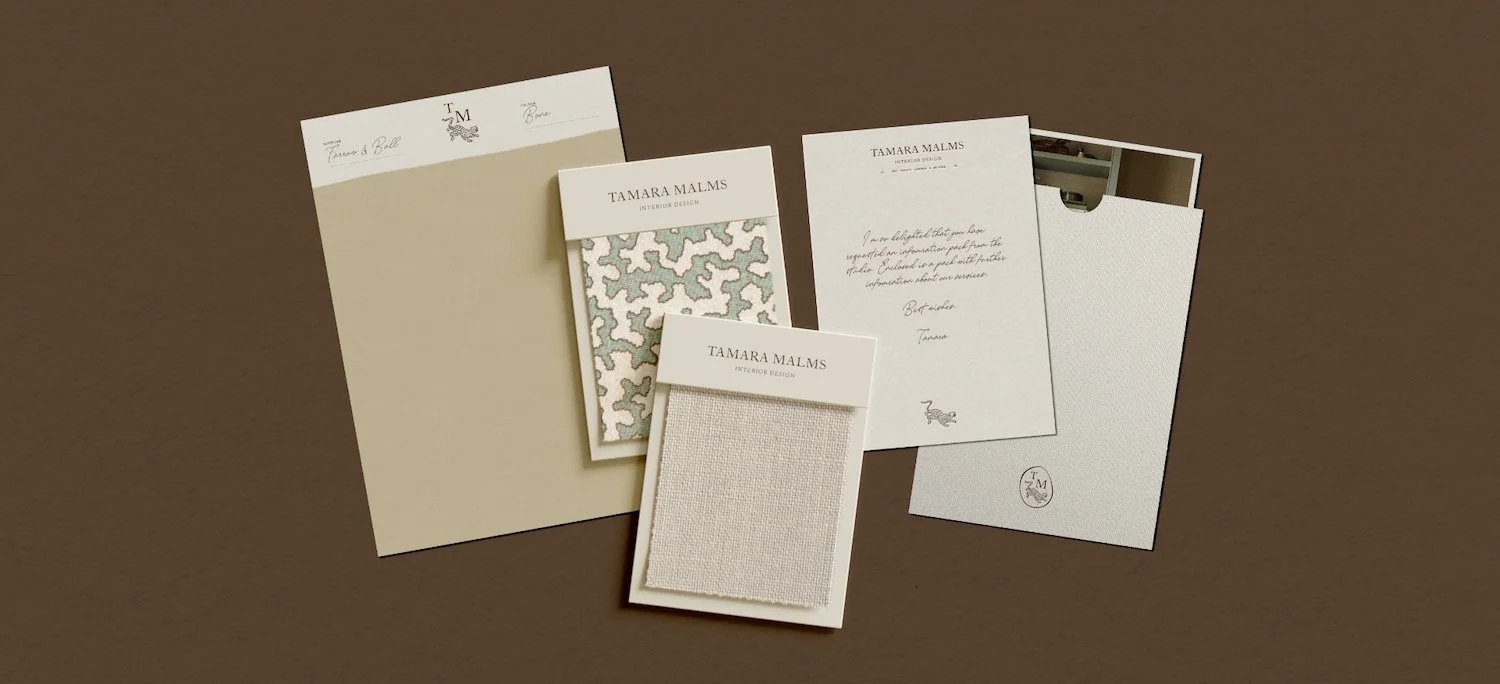
Tamara’s interior design brand stationery featuring a branded paint sample, branded fabric swatch holders and a business notecard
Example: a memorable brand identity for an interior designer
Tamara Malms is a great example of a brand identity for an interior designer. Tamara is an interior designer who blends playful colours with historic character, creating warm, nature-inspired spaces for characterful Swedish homes and clients worldwide. The reason Tamara’s brand identity stands out is because she invested in a comprehensive brand strategy component. This posed a strategic question: how to establish a professional, unique identity that could thrive in a Swedish market, known for 'Lagom minimalism' (balance and moderation vs. extreme minimalism). We did this by positioning Tamara as an interior designer who creates spaces 'bursting with personality, warmth and the abundant richness of nature.'
Explore Tamara’s interior designer brand identity on our portfolio →
Key ideas:
A clear brand strategy – Defines your style, values and ideal client to guide all branding decisions
A cohesive visual identity – Ensures your logo, colours and typography work across all touchpoints
A distinctive brand voice – Communicates your design philosophy and reinforces your positioning
6. How interior designers can build a distinctive brand identity
Branding may seem somewhat intangible and the kind of thing that you recognise when you see a good one. However, there is a well defined approach you can take as an interior designer to ensure that your brand identity is top-drawer. As you’ll probably notice, the key with this is defining your brand before attempting to design it. Trying to build your aesthetic before being clear on your brand fundamentals is a surefire way to get underwhelming results.
Define your design style, values and ideal client before designing your brand
This is critical and goes back to what we were saying about brand strategy. If you want to ensure your brand identity as an interior designer attracts and speaks to the right client, you need to define those key elements before the design work starts - well before. In fact, the first thing you need is clarity on your own business as an interior designer - your specific set of services; how much you charge for your interior design packages; and whether your upcoming branding process is part of a bigger pivot for your business.
Once you are clear on all of these fundamentals - to do with your business and your clients - you can then approach commissioning your brand identity. By doing this methodically and in the right order, you will have a much higher chance of getting a brand identity that works hard for your interior design business, winning you client with the right budgets and getting the chance to work on projects that bring you alive the most. If you are considering getting a brand identity done as an interior designer, ensure that you clarify what you stand for and whom you serve - this will make your brand more authentic, more impactful and importantly help guide you in your decisions for your business.
Develop a cohesive visual identity with considered colours, typography and imagery
When you work with a brand designer or branding studio on your brand identity, make sure that you take a holistic approach. (The best studios will do this as standard.) Key things to include within the brand identity process are a consideration of your brand’s colour psychology - namely what season of colour you fall into. Spring, summer, autumn and winter brands all have particular nuances and association so make sure you’re in the most relevant one that will give you the most leverage. When it comes to typography, similarly, chose a set of fonts that gives you flexibility in your marketing; free web fonts or premium fonts with the right licensing; plus a well curated set so you’re not overwhelmed with too many to choose from.
Lastly, a really cohesive brand identity will also include some consideration of brand photography, depending on your package. At the very least, as an interior designer, your brand identity should give you a steer on the kind of photography that suits your brand. Photography is a vital part of your branding toolkit alongside your brand assets and messaging. You should be able to use your brand identity to guide you when it comes to choosing a brand photographer - one that can capture the kind of images that ensure your interior design studio is recognisable and gets across your design aesthetic clearly to prospective clients.
Apply your brand consistently across your website, portfolio and marketing channels
Getting your branding or brand identity done as an interior designer is only half the battle. Implementing and rolling it out afterwards is another crucial part of the process. We see so many interior designers with lovely brand identities who then undermine the wonderful aesthetics and all the hard work by being inconsistent in how they apply their branding to their marketing channels. Applying your brand identity to your interior design business does not mean overlaying everything with your logo or using absolutely everything in your brand assets folder all of the time. In actual fact, less is more when it comes to applying your brand. For example, if you are updating your portfolio, put the emphasis on your client: how what you did to shine through, particularly if you have brand photos. Brand consistency is knowing what not to say or what to leave out, so focus on communicate the key ways you brought impact and transformation through the project. If you do this throughout your portfolio, you’ve gone a long way to apply your brand. Overall, consistency with your brand as an interior designer builds trust, reinforces your unique identity and helps potential clients remember your studio.
Key ideas:
Define your foundations before the designs start – Clarity on services, clients and direction leads to a more effective brand
Develop a cohesive and considered visual identity – Colours, typography and imagery should align with your positioning
Apply your brand consistently across all channels – Consistency strengthens recognition trust and recall
7. When interior designers should invest in brand identity
In an ideal world, every interior designer will have their own brand identity from the get go. However, we realise that reality often dictates otherwise: competing priorities, unexpected events or diverting budgets elsewhere. However, there are a handful of critical moments when it really pays off to invest in a brand identity for your interior design studio.
When launching a new interior design studio
One of the most obvious and most important times to invest in a brand identity as an interior designer is when you launch your new interiors business. The main reasons this is so important is firstly so that you stand out from everyone else, particularly bog standard interior designers; secondly, a brand identity will help position your interior studio which further helps you stand out, but also maximise your impact in a chosen niche or among a specific audience; and thirdly, a great brand identity will help you get off to a flying start by attracting the right kind of customer, rather than those without the right budget or with misguided expectations. The one caveat though is be careful not to over-invest in your brand identity. Yes, you want to spend once and get your branding right, but as a new business you need to be profitable, so don’t blow your startup budget before you’re profitable or pinning all your hopes on your branding.
When your interior design business has outgrown its current branding
You’ll know when you’ve outgrown your branding as an interior designer, as it simply won’t match up to your business aspirations or perhaps the level of your competitors anymore. One thing to look out for is a feeling that your branding no longer reflects the quality of work that you are currently doing or want to attract. This is a very natural process of evolution as you gain experience and grow. If you relate to that feeling, it’s a very good time to consider investing in a new brand identity in order to take your interiors business to the next level. Once you have been trading for a number of years, you’ll have much deeper insights into your customer base as well as what makes your business unique. This deep understanding of your setup and how you operate will allow a brand designer to craft your brand in the best way possible. Be mindful not to put off upgrading your branding for too long, as you will grow accustomed to your old look and lose the impetus to do something about it.
When you want to attract higher value interior design projects
Wanting to attract higher value projects as an interior designer is a natural feeling to have. The reality is that higher value projects make life easier because you don’t have to churn out so many for the same revenue level, plus you can pour more of your creativity and design flourishes into them. However, the big hurdle people encounter is that their business looks out of kilter with the level that their ideal clients are operating at. It’s really important as an interior designer that when a potential clients looks at you, they feel a sense of aspiration and that you’re someone who can get them where they want to go. A elegant, strategic brand identity is a vital piece of the puzzle if you are in this situation. It will help reposition your interior studio to align with your clients, communicate that you have the requisite expertise to deliver what they need plus have the aesthetic impact to appeal to more discerning clients.
Key ideas:
At the launch of a new interior design studio – A strong brand helps you stand out and attract the right clients from the start
When your current branding no longer reflects your work – Rebranding supports growth and repositioning
When aiming to attract higher value projects – A refined brand identity aligns your studio with more aspirational clients
Conclusion
In summary, building a professional brand identity as an interior designer is the most effective way to separate your studio from wannabes and attract high-net worth clients and high value interior projects. By prioritising a solid brand strategy before diving into the visuals (as tempting as it might feel), you will ensure that your interior design philosophy is best placed to resonate with your ideal clients' needs. Remember, a cohesive brand identity—spanning everything from your colour season to your vocal tone—ensures that you avoid the race to the bottom on price alone; instead it helps you compete based on your unique value and generating trust; much more fulfilling all round.
Which part of your brand identity are you going to refine first to start standing out? Share this post with a fellow designer who is ready to level up!
Frequently Asked Questions
-
A brand identity is the combination of strategy, visuals and messaging that shapes how you as an interior designer and your interior design studio is perceived. It includes key elements like your positioning, logo, colours, typography, tone of voice and the overall experience clients have with your brand. Brand identity generally refers to these tangible assets whereas branding refers more broadly to the entire customer experience of your brand. Note that they can be used interchangeably.
-
A strong brand identity helps you as a interior designer stand out in a very competitive market, communicating your design style clearly and attracting the right clients for your interior studio. A brand identity also builds trust and credibility through well-crafted aesthetics and relevant messaging before a potential client even gets in touch.
-
As an interior designer, you can build a strong brand identity with the following fundamental building blocks: define your design style and who it appeals to (your ideal client); develop a cohesive visual identity so that you look attractive to work with; apply your branding consistently across your website, portfolio and marketing channels so that you are recognisable and its easy to choose you as opposed to your competitors.
Read more: brand identity and interior design insights
The importance of building a strong brand identity for your interior design business
A practical industry guide explaining how brand identity helps interior designers stand out, attract the right clients and build long-term relationships in a competitive market
Examining the role of interior branding in retail design strategy (research paper)
Academic research showing how interior branding influences customer perception, engagement and sales performance through cohesive design experiences
Marketing in the interior design industry: key statistics and trends
A data-led overview of how clients find and choose interior designers, highlighting the importance of branding, visual content and SEO in attracting enquiries
About the author:
Simon Cox is the co-founding director (along with his wife, Rachael Cox) at Wildings Studio, a branding, website design and content marketing studio in Torquay, UK. He’s the writer and editor of the Wildings Studio blog which you’re currently reading. Simon is also responsible for the Wildings Studio content marketing services. Simon blogs regularly on topics to do with the core Wildings Studio services on branding, website design and content marketing (blogging). He’s passionate about helping small business develop great content that answers the questions people type in Google in order to get found online (SEO).




In this article:
Why standing out as an interior designer starts with your brand identity
Ten top takeaways on brand identity for interior designers
Free: Interior designer’s brand map
Why does the interior design market feel so saturated today?
Common branding mistakes that stop interior designers standing out
How a strong brand identity helps interior designers stand out
Key elements of a memorable brand identity for interior designers
How interior designers can build a distinctive brand identity
About Wildings Studio
Thoughtful, beautiful branding and websites for design-led businesses
Wildings is a website designer for small businesses offering website design. Based in South Devon, UK, we deliver small business website design for design-conscious brands like garden designers, interior designers, architects, circular ethos restaurants, speciality coffee shops, organic cafés and boutique hotels.